

ESR Technology / ESTL / What We Do / Solid & Fluid Lubrication
ESR Technology / ESTL / What We Do / Solid & Fluid Lubrication
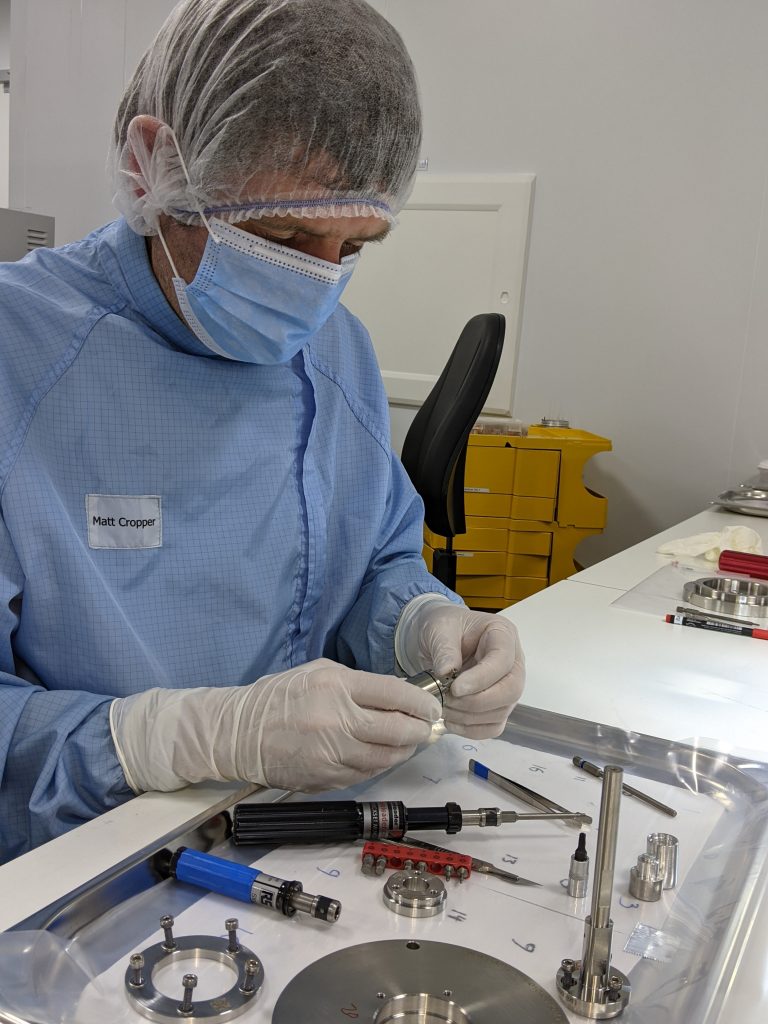
As a solid lubricant technology pioneer within Europe during the 1980’s and primary source of expertise in the field of solid lubricants since then, we now have a long and successful track-record as a vendor of solid lubricants to the space industry worldwide.
Solid lubricants are well established for use in space and can offer both technical and programmatic benefits. They provide the only viable means of lubrication where oils and greases cannot be used, for example at temperature extremes or where there is the need to avoid molecular contamination and require no special anti-migration or anti-creep measures.
Our solid lubricant products have been adopted and qualified for space by many clients, often in the most demanding of space applications.
We offer a number of different solid lubricant solutions. Our heritage products have been provided for many years and so are supported by extensive test data having been qualified and flown by many clients. Additionally, over recent years we have been engaged in the development of a range of next-generation solid lubricant products which offer lifetime and other performance advantages. Though today our next generation products have less flight heritage, they are generating considerable interest. Several of our existing clients are beginning to switch to next generation solid lubricant products for their own new developments or considering delta-qualification in mature mechanisms, and new clients perhaps for the first time, are considering solid lubrication based on the promise of these next generation products.
For applications that are better suited to fluid lubrication, we offer a full bearing procurement and lubrication service, including arranging manufacture and where appropriate impregnation of cages (to ESTL’s established standard process or client specified process).
ESTL places considerable emphasis on providing solutions to lubrication problems, rather than simply depositing lubricants or providing a fluid lubricated bearing.
To date ESTL has lubricated over 5,000 components, both for space flight and for research and development purposes, contributing to virtually every European space programme and many programmes from elsewhere around the world. Batch sizes from 1 up to >100,000 items can be handled – with the latter being common for non-space applications and occasionally requested for the new-space market.
All of our activities are executed within a quality management system accredited in line with EN9100:2018 (AS9100).
Thin films of MoS2 when formed by sputtering can, primarily in vacuum, exhibit ultra-low friction behaviour. The principal advantages of MoS2 are:
In addition to our heritage MoS2 formulation (known as “MoS2-101”), we now have a number of variant products with well-defined and tightly-controlled processes which offer promising performance benefits. In some cases, these are MoS2 formulations closely related to -101 benefitting from relatively minor process refinements, in other cases these are non-stochiometric variants. To differentiate heritage product all variants are identified by codes e.g. MoS2-202, MoS2-301, and MoS2-Star.
Our variant programme is ongoing and some of these variants are in the later stages of validation testing and even under early adoption and qualification at mechanism level by some clients.
Lead as a lubricant is well suited to operations in combined sliding and rolling motion (ball bearings, gears, ball-screws etc). The principal advantages of lead are:
Sputtered silver is a lubricant also well suited to sliding and rolling applications, but particularly for those operating at elevated temperature in vacuum.
We offer fluid lubrication of components of all kinds, including lubricants applied at sub-assembly level if needed. We can provide support or advice on lubricant choice for the application, design and manufacture bearing cages, procure lubricants and process bearings including assembly, preload and run-in.
We have processes compatible with all common space oil and grease chemistries (and a capability to handle other lubricants, e.g. ionic fluids). We offer bespoke surface pre-treatments to improve boundary lubrication performance, and application of the fluid lubricant in conjunction with a degradation barrier.
Our recent work on hybrid lubrication (in which optimal amounts of solid and fluid lubricant used together synergistically enhance life) is also attracting some early commercial application.
Typically, bearings are used together with a complementary cage (retainer/separator). Cages can be metallic or polymeric including so-called self-lubricating composite materials, and established combinations of cage material and lubricant are well known which provide low torque noise and long life. We can design and manufacture compatible bearing cages, whether for use with our solid lubricants, in a self-lubricating mode, or for with fluid lubricants (oils or greases).
In some cases, it can be appropriate to rely only on the transfer film lubrication generated by a “self-lubricating” cage material. In such cases, we can offer cage design, manufacture, assembly and run-in if needed.
In the case of fluid lubricants, a common heritage solution is to employ a vacuum impregnated phenolic material, and we can offer design, manufacture and impregnation of such cages (in line with established processes) as part of our service where needed. Where needed, we can simply process the cages and provide them to our clients in ready-for-use form.