ESR Technology / HOIS / Publications / HOIS Highlights 2025-2026 / Project Progress / Inspection for SCC Cracking: Uncoated Austenitic Stainless Steel Components
Stress corrosion cracking (SCC) in austenitic stainless steels is difficult to detect and actual sizing of the crack extent is very hard or even impossible with the current techniques due to ultrasonic transparency of tight cracks.
Detection of the surface breaking cracks is challenging when cracks are fine and especially if the surface has been blasted prior to application of dye penetrant testing (PT).
A previous exercise by a HOIS member on the inspection of ex-service austenitic stainless steel samples with stress corrosion cracking, showed that PAUT could detect larger cracks (with a depth of ~50% WT), but the finer, branched cracks were not detected, some of which had a depth of approximately 75% of the wall thickness of the component.
The focus of this work is therefore on the detection and sizing of the finer, branched cracks that can sometimes progress deeper through the material than the larger cracks.
Five trialists took part in the trials, and used the following approaches:
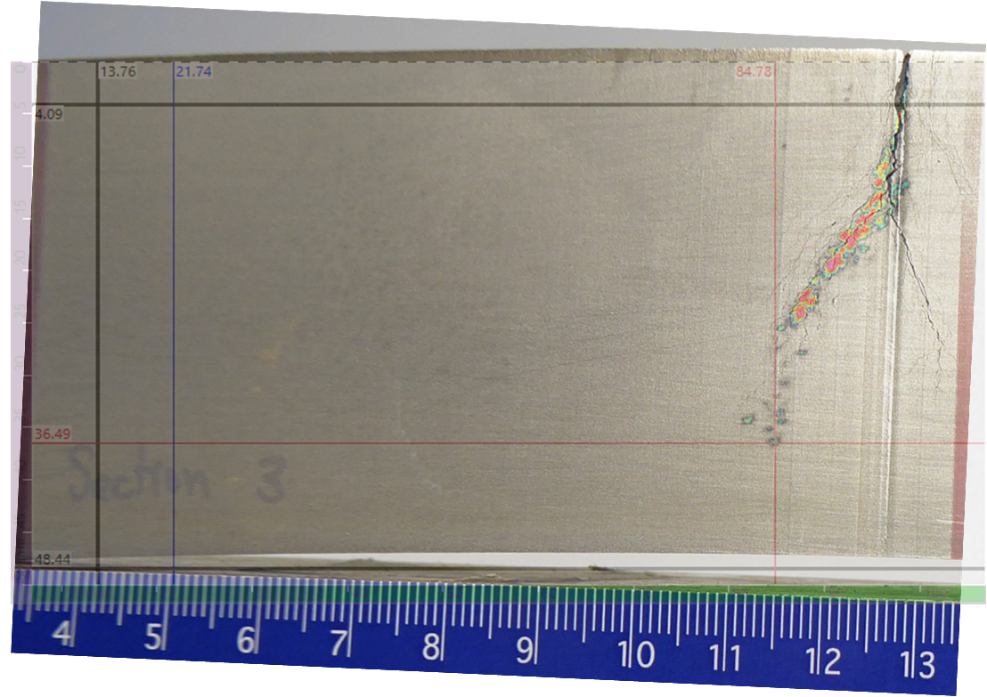
Following the trials, the blind sample was sectioned at intervals and the minimum remaining wall thickness mechanically measured to make comparisons with the trialist results. The B-scans from the phased array based trials were also compared with the cross-sections of the cracking.
The PAUT-based trials and TOFD showed good correlation with the benchmark data. There was also a good correlation between the B-scans and the corresponding cross-sections containing the cracks.
Further information is available in the confidential HOIS trial report which was completed in Q3 of 2025.
This project is now complete.