

ESR Technology / HOIS / Publications / HOIS Highlights 2025-2026 / Project Progress / Inspection of Composite Repairs
ESR Technology / HOIS / Publications / HOIS Highlights 2025-2026 / Project Progress / Inspection of Composite Repairs
Composite wraps are increasingly used for defined lifetime repairs of corrosion damage on pipes. These wraps are manually applied on site and left in place until either the end of its designed lifetime or the next planned maintenance interval, where the pipe section can be replaced. After installation, it is essential to inspect the region where the composite wrap was applied – initially to confirm correct installation and subsequently, to monitor the integrity of the wrap and ensure that further degradation has not occurred.
However, due to the composite nature of these repairs, many conventional inspection methods applied to metallic pipework are unsuitable for these repaired regions. Although various techniques have emerged in response to the increasing use of composite wraps, many of these methods have not undergone independent testing to validate the claims of their developers. Consequently, the expected lifespan of a composite wrap repair remains limited, and a large number of repaired pipes are replaced before the end of the designed lifetime.
A number of standards, guidance documents and best practice documents have been developed in the last few decades to help with the design, installation and inspection of the composite repairs. This includes HOIS-G-027, issued in 2020, which was developed by HOIS based on past projects (C16-02 and C17-03) to provide guidance on the inspection of composite repairs. A number of technologies were assessed comprehensively in this guidance document. However, since then new inspection tools and new wrapping technologies have been developed. As a result, there is a need to assess these new technologies for potential inclusion in an updated HOIS guidance document HOIS-G-027.
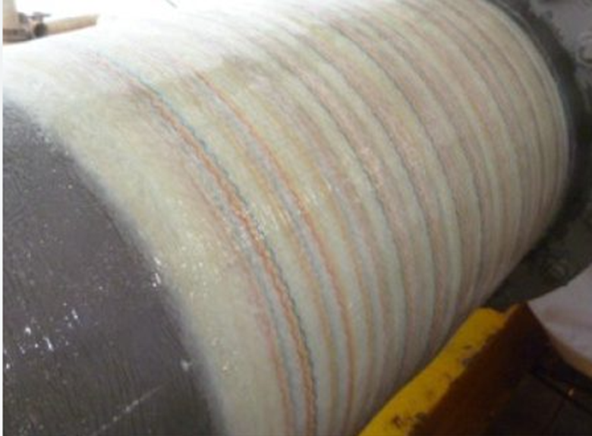
The samples required for the open trial have been designed by ESR and manufactured by three repair service providers. The aim of the open trials is to provide trialists with an opportunity to refine their inspection approach and to provide information on the suitability of the samples. The open trial are planned to start in April 2026. The initial design for the blind trial samples has also been completed and will be modified based on the learnings from the open trials.