

ESR Technology / HOIS / Publications / HOIS Highlights 2025-2026 / Project Progress / Pipework Analytics & Inspection Optimisation
ESR Technology / HOIS / Publications / HOIS Highlights 2025-2026 / Project Progress / Pipework Analytics & Inspection Optimisation
Pipework inspection is carried out on plants, to reduce the risk of loss of containment of process fluids. By identifying and characterising corrosion, and other degradation mechanisms, planned maintenance, and other forms of mitigation, can be carried out in a timely manner to avoid leaks and unplanned outages.
Inspection provides information to estimate the current integrity state of the pipework (e.g. by estimating the overall minimum wall thickness from wall thickness readings) and the future integrity state (e.g. by estimating the corrosion rate and calculating the remaining life). Sufficient inspection needs to be carried out to make these estimates accurate enough to be useful but beyond an optimum point there will be diminishing returns, with more inspection adding cost but not adding to the understanding of the underlying corrosion behaviour of each system and the integrity state of the asset.
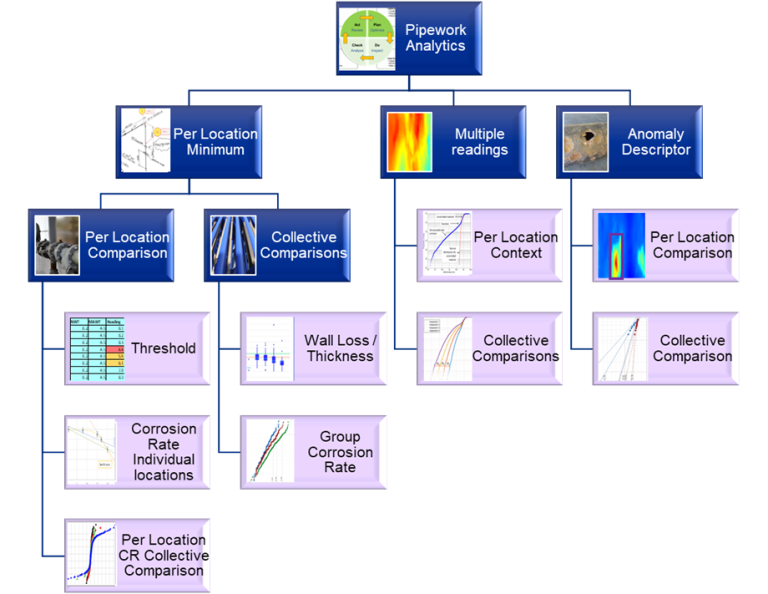
The Phase 1 report discussed the strengths and limitation of different available analytical options for pipework inspection. The Phase 2 report used real data, provided by HOIS member companies, to compare the application of different analytical approaches to pipework analytics. It highlighted the difficulties of applying a traditional per location corrosion rate under conditions of changeable corrosion rates and investigates the use of grouped integrity corrosion rates, which can be used to bridge the inspection frequency gap between longer interval use of per location corrosion rates for low corrosion rates and continuously installed monitoring. Practical examples are provided that demonstrates that by combining analytical tools from different approaches, whilst understanding the limitations of each, provides the ability to cross check findings and gain greatest integrity insight.
This project has been completed with the issue of a guidance document.
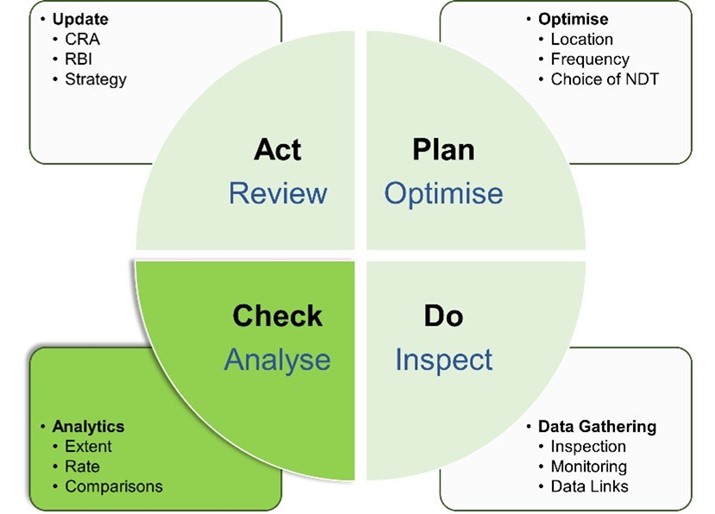
The aim of this document is to provide guidance to improve pipework inspection for internal degradation mechanisms primarily through improved use of pipework analytics and choice of NDT technique. To understand the impact and benefits of expanding the choice of pipework analytics and the choice of inspection and monitoring techniques, it is necessary to consider the whole inspection cycle.
The document focuses on the impact of changes to pipework inspection, that can be implemented to the delivery of inspection and to the analysis of inspection results to leverage the benefits of improving delivery of advancing non-destructive testing (NDT) techniques increasing data storage, and analytical computing power. The key factors to improve pipework inspection efficiency and effectiveness and how they interrelate are discussed.