

The next step in our mission of continuous improvement for European space bearing analysis capability.
What is this about?
CABARET, ESTL’s own bearing analysis software, having its roots in rocket engine turbopump development (hence its name – Code for Analysis of BeArings in Rocket Engine Turbopumps), has a 35-year history of serving the specific analysis requirements of the European space industry, with the funding and support of the European Space Agency (ESA). Since the launch of CABARET 3, in 2021, CABARET has evolved into a general analysis tool for space ball bearings, allowing mechanism engineers to assess the preload, stress, stiffness, gapping, thermal envelope, torque margins, and truncation requirements; as well as fluid lubrication regime, cage stability, vibration, fatigue, and general margins of safety. CABARET is nowadays used by 116 entities, including a wide range of Institutions, Large companies, and SMEs, in 21 of the 30 ESA Member and Cooperating States.
To keep up with modern requirements, CABARET 3 is based on the versatile Matlab platform, with a modern GUI and allowing for a fast pace of development. ESA and ESTL offer continuous user support, for troubleshooting, bug reports, training, and bearing analysis consultancy.
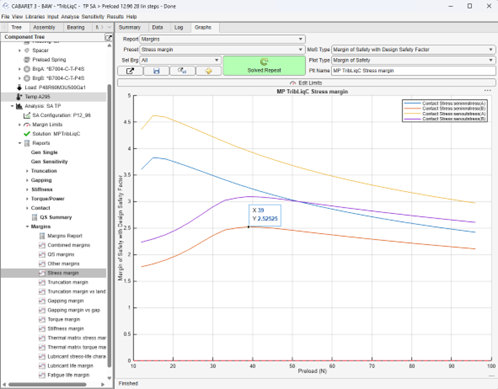
CABARET graph of Peak Hertzian stress margin as a function of preload – a means to optimise the preload to increase margins for a specific load case.
What’s new?
CABARET v.3194 is a fairly substantial update that hopefully considerably improves the ease of working with CABARET. A total of 76 changes were logged since the previous version (v3193, released in March). Highlights of this update:
UI Improvements:
- Graphs Dropdown Menu and Sensitivity Analysis parameter selection Menu made more navigable, with a tree-like structure.
- Dark Mode
- The Component Tree can now be docked in a Tab on the Left Panel.
Capability:
- Conformity estimation from Load Rating and vice-versa.
- Revamped Thermal Conductance inputs panel related to conductance through-the-bearing.
- Gapping: Revised criterion for critical gap based on predominant load direction.
- Libraries: Extended properties and UI functionality in Material and Fluid Libraries.
- Added slip velocity and traction magnitude, sliplines, and vector field plots to better visualise what is happening friction-wise inside the contacts.
Important fixes:
- Lubricant switching from solid to the first fluid on the Library after loading an input file.
- Default settings of raceway control coefficients incorrectly set under Quasi-Dynamic option.
- Flash temperature affecting traction results at zero speed.

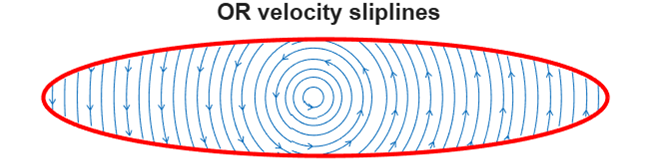
CABARET plot of the slip velocity field inside the contacts of a ball bearing, involving combined rolling and spinning; Above: Inner Ring; Below: Outer Ring
What lies ahead?
Further development of features follows industry needs, with focus on supporting users through the bearing sizing process for space mechanism development (a.k.a. “Guided Mode”), and multi-bearing support. Significant improvements in thermal and torque modelling are being researched.
CABARET’s philosophy, as a tool for bearing design, is to allow engineers to systematically explore the options in bearing selection and assembly/ operational parameter space and be able in the end to distil the quantitative results of extensive analysis into justified records for design choices. As the software’s capabilities expand, its role in streamlining rather than complicating the design process becomes ever more important.
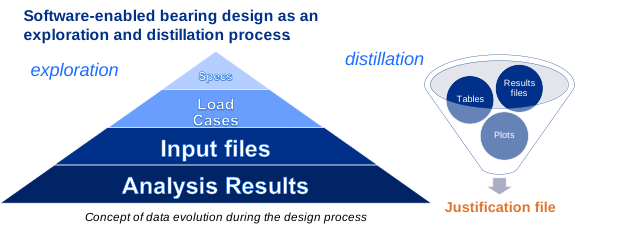
Concept of data exploration and distillation during the design process
We aim to continue updating CABARET, with a launch cadence measuring up to the pace of the space industry. Stay up to date with CABARET updates by joining our mailing list and, if you are already using CABARET, by checking for updates from the software’s “About” menu.