An important aspect in mechanism design is the selection of the appropriate lubricant for given operating conditions. In the case of fluid lubricants, it is important to understand the lubrication regime a given application will be operating in. For long life applications operation in the full fluid film regime as much as possible is optimal for life. High speed mechanisms, such as reaction wheels typically operate for much of their time in this regime, with operation above the EHL transition, whilst mechanisms such as SADMs and pointing devices may never run fast enough to operate outside of the boundary regime where the lubricating film thickness and load support provided by the fluid film itself is very low. Understanding lubricant properties across these regimes is key to selecting and utilising fluid lubricants effectively.
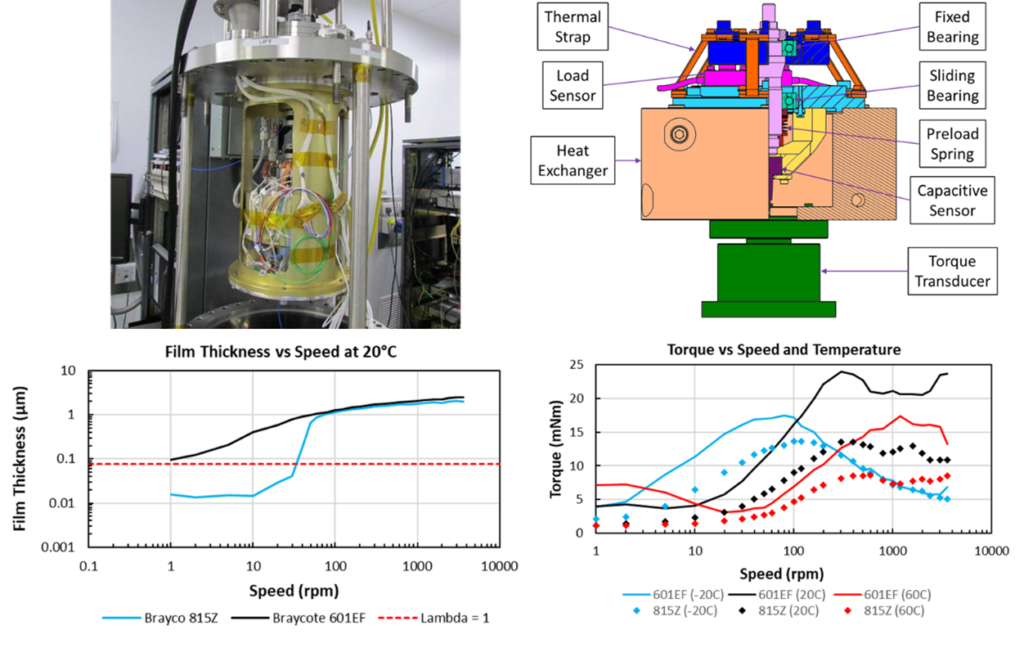
The Advanced Bearing Test Rig (ABTR) is ESTL’s highly instrumented research and development bearing test rig. Along with the usual capabilities of a bearing test rig, to measure torque, temperature, and control environment, the rig has a number of unique capabilities which allow it to be used for more detailed investigations:
- Film thickness measurement in the upper bearing, which can be used to assess fluid film thickness, and solid lubricant transfer and wear behaviours.
- Resistance measurement through the two bearings, which can be used to determine the fluid lubricant regime the bearings are operating in.
- Preload measurement between the two bearings, confirming that preload is maintained, and identifying effects which might cause a rise in preload – and thus impact torque.
Between these capabilities, the ABTR can be used to carry out in-depth investigations into the performance of bearings and their lubricants. One recent activity where ESTL has used this facility was to investigate the behaviour of one of the most commonly utilised PFAS-based space lubricants, the PFPE-based, PTFE thickened grease, Braycote 601EF, along with its base oil Brayco 815Z. These lubricants were tested over a range of temperatures (from -20 to +60ºC), preloads, and speeds, and their behaviour characterised.
Both lubricants demonstrated the expected Stribeck Curve behaviour, with torque rising with speed as the film thickness rises, until a point where shear thinning and starvation begin to lower the film thickness and reduce torque. Braycote 601EF demonstrated consistently higher torque than its base oil, with its higher apparent viscosity requiring more effort to shear within the bearing contacts. This effect is particularly prevalent at higher speeds.
Compared to its Brayco 815Z base oil, the Braycote 601EF grease exhibited approximately equal film thicknesses at higher speeds. However, as the speed reduces and regime shifts to boundary, the grease displayed larger film thicknesses, with the PTFE thickener particles present in the grease working to separate the two surfaces even when the fluid component of the grease is unable to.
This study perfectly demonstrates that whilst the commonly used analytical models can provide an approximation of the fluid lubrication conditions for a bearing (or other tribological) system, these models should not be used as absolute truth, particularly for formulated grease products which can diverge significantly from the analytical predictions. Only through direct testing under representative conditions can the performance of a fluid lubricant truly be assessed, and the performance of the lubricant in an application be derisked.
In the coming months ESTL will be using this unique facility to investigate the novel PFAS-free vacuum grease developed by our colleagues at Materiales, as part of an ESA-supported and GSTP-funded activity. Testing will characterise this new grease, and provide a direct comparison against the existing Braycote 601EF grease over a range of applicable space-representative conditions.
A technical memorandum detailing how the ABTR can be used to characterise fluid lubricants for space and vacuum applications is available on ESTL’s Members’ Area (accessible upon registration only to entities within the ESA Member and Cooperating States): ESA-ESTL-TM0273 01-: ABTR Further Fluid Lubrication Study
If you would like to learn more about fluid lubricant characterisation, bearing testing, or other areas of research undertaken at ESTL, please feel free to get in touch.