Hybrid lubrication is the application of a viscous fluid lubricant, typically a low-vapour-pressure oil, on top of a thin-film solid lubricant coating, most commonly sputtered molybdenum disulphide (MoS₂).
At ESTL, we first began investigating the potential benefits of hybrid lubrication in 2012. Since then, we have completed multiple tribological R&D projects investigating its application, from tribometer-level studies through to component-level testing, to demonstrate and characterise hybrid lubrication for space applications. Our work has identified several key potential benefits to combining fluid and solid lubrication systems.
- Protection of the solid lubricant during ground exposure: The fluid lubricant can provide protection to an MoS₂ coating from exposure to moist air before during on-ground operation. This has the potential to reduce environmental degradation of the coating and extend its subsequent operational life in vacuum.
- Protection of the fluid lubricant from degradation: The solid lubricant coating can provide a barrier between a PFPE-based fluid lubricant and the underlying steel surface. This may act to reduce the interaction between the lubricant and catalytic metal surfaces and therefore help mitigate the tribo-degradation mechanism associated with PFPE lubricants.
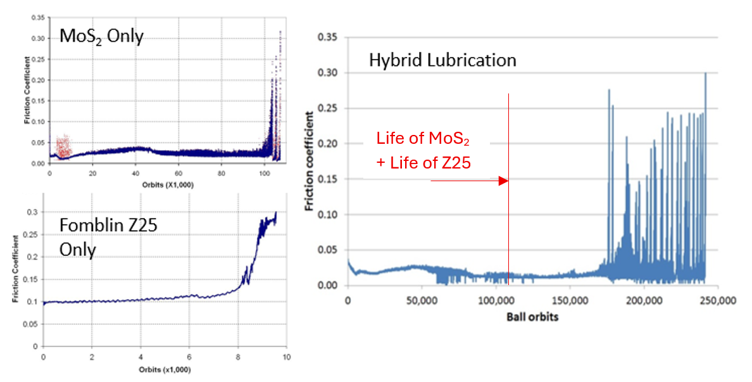
- Synergistic extension of lubricant lifetime: Perhaps the most interesting observation from our investigations is that hybrid systems can, under certain conditions, provide a synergistic increase in operational lifetime. This increase in lifetime can be achieved without compromise of the friction coefficient, retaining the low torque and friction characteristics associated with MoS₂ while achieving a lifetime greater than the sum of the lubricant systems combined
Finding the optimum fluid lubricant quantity
ESTL presented a paper on hybrid lubrication at the European Space Mechanisms and Tribology Symposium in 2021, summarising our research to that point. One of the key findings presented in that study was the complexity involved in determining the optimum quantity of fluid lubricant required to achieve this synergistic extension in lifetime. Too little fluid lubricant can provide insufficient benefit, while too much can cause the system to transition towards fluid-dominated behaviour.
Our experimental results identified four distinct regions of behaviour:
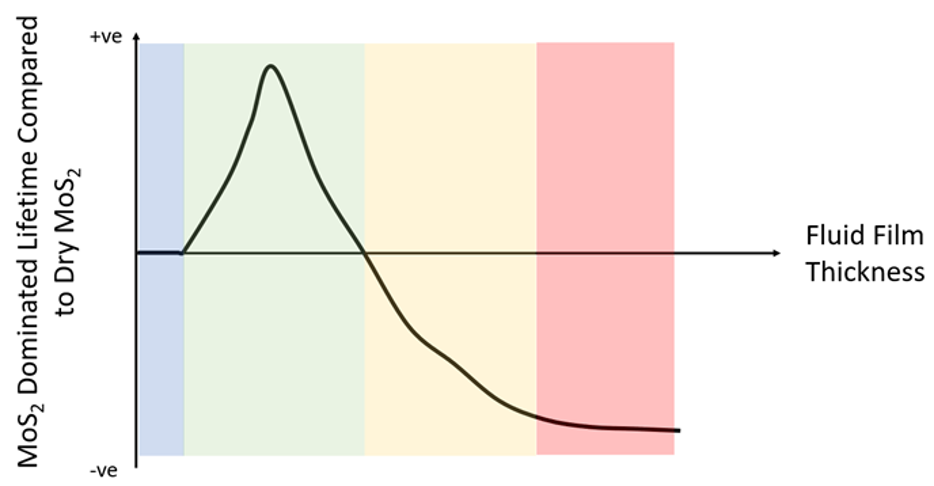
- Blue: MoS₂-dominated behaviour, with both friction and lifetime characteristic of the solid lubricant.
- Red: Fluid-lubricant-dominated behaviour, with both friction and lifetime characteristic of the fluid.
- Yellow: Reduced lifetime compared with MoS₂ alone, but with friction remaining MoS₂-dominated.
- Green: Extended lifetime while retaining MoS₂-dominated friction behaviour.
The objective of hybrid lubrication is therefore to operate within the green region: achieving an extension in lifetime without losing the desirable tribological characteristics of the solid lubricant.
What determines the required fluid film thickness?
Our 2021 work highlighted that there is unlikely to be a single optimum fluid film thickness applicable to all applications. Instead, the required quantity of fluid lubricant is likely to depend on the wider operating conditions.
One hypothesis considered in the study was that the concentration of wear debris within the fluid film could be an important factor. Contacts generating larger quantities of debris (for example, through higher applied loads) could require a greater fluid film thickness to maintain the beneficial hybrid behaviour. This provides a potential explanation for why the optimum fluid quantity can vary significantly between different operating conditions.
Extending the operating envelope
Our ESMATS paper also considered how hybrid lubrication could potentially enable the use of fluid lubricants across a wider range of conditions than might initially be expected from fluid-only lubrication.
Two factors here are particularly relevant.
- Firstly, conventional approaches such as the Langmuir equation become less directly applicable when considering the extremely small quantities of lubricant involved in these systems.
- Secondly, the presence of the solid lubricant means that the viscosity of the fluid lubricant can become less critical at low temperatures than it would be for a fluid-only lubricated contact. The MoS₂ coating can continue to provide the primary lubrication mechanism even as the fluid becomes increasingly viscous.
The way forward
Hybrid lubrication remains an interesting approach for spacecraft mechanisms, offering the possibility of combining the environmental robustness and low-temperature performance of solid lubrication with some of the benefits provided by fluid lubricants. Our ongoing work is helping to better understand the conditions under which these two lubrication mechanisms can work together—and, importantly, when they do not. The most recent work at ESTL has targeted investigating this in more detail, including activities to explore the following.
- Examinations of the relationship between operating conditions, debris generation and the fluid quantity required to achieve extended hybrid-lubricant lifetime.
- Investigations of the potential use of fluid lubricants specifically for on-ground protection of solid lubricant coatings, with the aim of protecting MoS₂ prior to operation in vacuum.
Both studies have concluded, and the resulting technical papers are available to members through the ESTL Members Area of the ESR Technology website.
If this topic of hybrid lubrication interests you, or you are curious about the applicability of this lubrication regime to your application, please feel free to reach out to the ESTL team.