For many decades, spacecraft mechanisms have relied heavily on per- and polyfluoroalkyl substances (PFAS). Perfluoropolyether (PFPE) lubricants, PTFE-thickened greases and fluorinated solvents have become the industry’s trusted “heritage” materials, enabling reliable operation across extreme temperatures and hostile space environments. However, this long-established position is beginning to change.
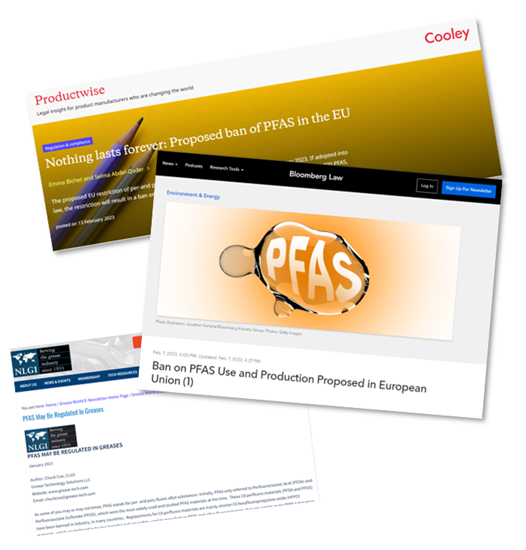
Growing environmental concerns surrounding the persistence of PFAS materials (often referred to as “forever chemicals”) have prompted the European Chemicals Agency (ECHA) to evaluate restrictions covering more than 10,000 PFAS substances under the REACH framework. While the final outcome of this review remains under discussion, and derogations for the space sector continue to be considered, the overall direction of travel is clear: the availability of PFAS-containing materials is expected to become increasingly restricted over the coming years.
Considering lubricants, this may have significant impacts on the European space industry, with common products such as Braycote greases and Fomblin Z25 oil at risk. However the concern is not only relevant to the lubricants themselves, with the implications of these potential upcoming restrictions extending much further. A typical lubrication system for a space mechanism application depends on an ecosystem of supporting materials. Alongside the PFPE lubricant are fluorinated solvents used for cleaning and lubricant handling, fluorinated anti-creep barriers that restrict lubricant loss via migration, and PTFE commonly used as a grease thickener (not only for PFPE-based greases). The continued viability of PFPE-based lubrication therefore depends on the availability of all of these materials, and not simply the oil or grease.
As an example, the recent withdrawal of products such as 3M’s Novec™ fluorinated fluids has already demonstrated how supply chain changes can affect the space sector long before legislation comes into force. Even if space applications ultimately receive a derogation allowing continued use of PFPE lubricants, there is no guarantee that manufacturers of specialist solvents and process materials will continue to produce them in the relatively small quantities required by our industry. In practice, maintaining a PFPE lubrication system may become progressively more difficult, more expensive and more reliant on fragile supply chains.
The present challenge therefore extends beyond preserving today’s heritage products. It requires the development of entirely new fluid lubricants that are independent of PFAS chemistry while maintaining the performance and reliability demanded by spacecraft mechanisms (low outgassing, long life under vacuum, low torque performance). Alternative lubricant families such as multiply alkylated cyclopentanes (MACs) already play an important role but, whilst useful, their operating envelope cannot fully replace PFPE lubricants across all applications, particularly over wide temperature ranges. Consequently, identifying new lubricant chemistries capable of delivering comparable, low volatility, and tribological life has become an increasingly important research priority.
Among the most promising candidate chemistries are ionic liquids (ILs). These designer fluids offer the potential to tailor lubrication performance through molecular design while completely eliminating dependence on PFAS chemistry. Of course significant verification and application-specific validation work remains ahead, and ESTL are proud to say that we are presently working on a collaborative project together with Materiales to develop and demonstrate this next generation of spacecraft lubricants. Over the course of the next weeks, we will describe this project to develop PFAS-free ionic liquid greases for future European space mechanism applications in more detail.